
Council Meetings & Key Documents
Meetings
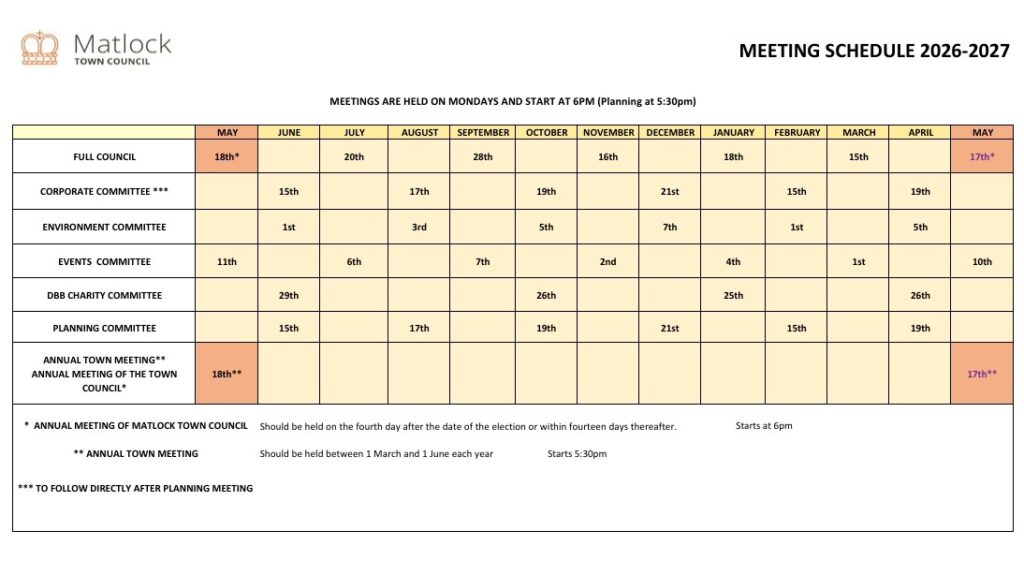
The full Council meets bi-monthly on the third Monday at 6pm. They have an ‘open door’ policy for all of their meetings except where confidential matters are discussed.
Our current schedule of meetings can be seen above
All meeting take place at the Imperial Rooms and start at 6pm with the exception of the planning committee which begins at 5:30 and is followed directly by the corporate committee meeting which begins at 6:30pm
Annual Meetings
The Annual Town Meeting is a meeting of all the local government electors for the Town. It is NOT a meeting of the Town Council. Every English parish must have a parish meeting which must assemble annually on a day during March, April or May each year. In Matlock this meeting is usually held in May.
The Annual Meeting of the Council is quite different to the Annual Town Meeting. It must be held in May in all but election years. It is the meeting where the Chair /Mayor is elected, Council members are appointed to committees and to serve on outside bodies, the structure of the Council is reviewed and if necessary, amended, reports are given and policies reviewed. It is, in effect, our Annual General Meeting.
Key Documents
Good governance, accountability and transparency are essential to local councils and a cornerstone of the government’s approach to improving public services. Matlock Town Council are committed towards making their policies, procedures and other key documents as useful, complete and ‘user friendly’ as possible and regularly review their content.
Corporate Documents
A local council is a corporate body with a legal existence of its own. Its decisions are the responsibility of the Council as a whole and not individual members. Our Standing Orders play an essential part in helping us achieve this. They are the Council’s ‘rule book’ and help us operate smoothly.
The Code of Conduct, which is adopted by the Council, is a legal document that guides individual Councillors, making sure that they maintain proper standards. The essence of the code is that they agree to act openly and honorably in the public interest.
In addition, individual council members, sign a register of interests – a formal registration of their financial and other specific interests that may affect their decisions. On this website, these forms are included within the profile of each Councillor.
Matlock Town Council also produces a strategy document which outlines their 4 year plan and an Annual Report which states our financial position and provides an overview of activities in any one year. The strategy document is reviewed in the months following a Local Council Election and helps the Council focus on their priorities in their term of office.
Councils thrive on meetings. Council meetings are formal events that have a clear purpose. The press and public have a right to observe how the council operates except where sensitive issues are discussed and can speak at the start of our meetings. The Council decides upon a schedule of meetings at their Annual Meeting each year. Each committee has members appointed by the Council and have Terms of Reference agreed by the Council, to which they must adhere.
Financial Accountability
Rules set by Government are designed to make sure that the council takes no unacceptable risks with public money. Councillors share responsibility for financial management of the council. A council must have its own financial regulations giving details of how the Council manages its finances.
As part of our audit process, we are required to inform people wishing to inspect our accounts of a period of time in which they are available. A notice containing this information and a breakdown of our unaudited accounts are displayed on the Matlock Town Council noticeboard outside the Imperial Rooms and on this website throughout this time. Once audited a notice of the conclusion of audit is displayed.
They also produce a budget which is an essential tool for controlling the council’s finances. The Council keeps a check on this by checking spending against budget plans on a regular basis at council meetings.
Legislation governs how the Council should behave when accounting for the public funds that we manage. As a result of this legislation, we complete an Annual Return each financial year. This document fulfills our statutory accounting requirements and is completed by the Council, Internal and External Audit.
Transparency
Councils hold a lot of private information; some of it must be handed over to members of the public who ask to see it and other private information must be kept private. In order to help us manage this, we have adopted a Publication Scheme which outlines the documents that we share and how to obtain them and we produce and adhere to a Data Protection Policy.